Debits and Credits Explained: Why Beginners Get Confused (and How to Fix It)
Debits and credits are one of the first things accounting students learn, and one of the most confusing. This post explains the concept in plain language, clears up the most common mix-ups, and gives simple tricks to remember which side to use.
The Concept That Confuses Almost Every Beginner
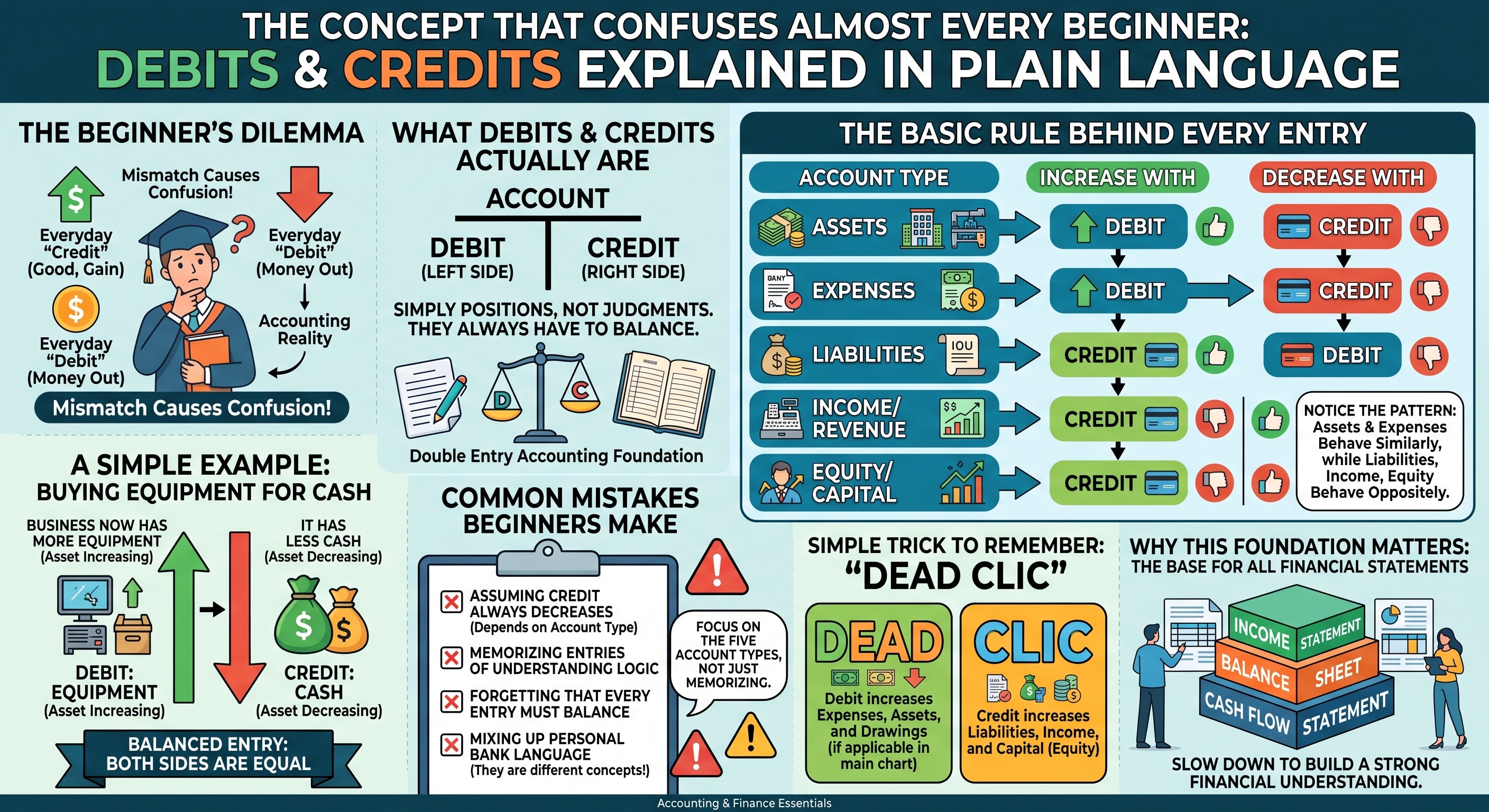
If you're new to accounting, there's a good chance debits and credits were the first thing that made you stop and think, "wait, that doesn't make sense." In everyday language, "credit" usually means something good, and "debit" sounds like money going out. But in accounting, these words don't work the way we normally use them. That mismatch is exactly why so many students get stuck early on.
The good news is that once the logic clicks, it stays with you for good. Let's break it down in plain language.
Forget the Everyday Meaning
The first step is to stop thinking about debit and credit the way your bank uses them. In accounting, debit and credit simply mean "left side" and "right side" of an entry. That's it. They are positions, not judgments of good or bad, gain or loss.
Every single transaction in accounting is recorded using double entry accounting, which means every entry has two sides — a debit and a credit — and they always have to balance. This is the foundation of the entire accounting system, so getting comfortable with it early makes everything after it easier.
The Basic Rule Behind Every Entry
Here's the part that actually matters: whether an account increases with a debit or a credit depends on what type of account it is. There are five main types of accounts, and each one behaves differently:
- Assets increase with a debit, decrease with a credit
- Expenses increase with a debit, decrease with a credit
- Liabilities increase with a credit, decrease with a debit
- Income increases with a credit, decrease with a debit
- Equity increases with a credit, decreases with a debit
Notice the pattern: assets and expenses behave one way, while liabilities, income, and equity behave the opposite way. Once you memorize this split, most journal entries start to make logical sense instead of feeling random.
A Simple Example
Imagine a business buys equipment for cash. Two things happen: the business now has more equipment (an asset increasing), and it has less cash (also an asset, but decreasing). So the entry would be:
- Debit: Equipment (asset increasing)
- Credit: Cash (asset decreasing)
Both sides balance, because the two entries are equal in value. This is the core idea behind every transaction, no matter how complex it eventually gets.
Common Mistakes Beginners Make
- Assuming credit always means a decrease. It depends entirely on the account type — credit increases liabilities, income, and equity.
- Trying to memorize entries instead of understanding the logic. Memorizing individual transactions doesn't scale. Understanding the five account types does.
- Forgetting that every entry must balance. If your debits and credits don't add up to the same total, something in the entry is wrong.
- Mixing up personal banking language with accounting language. A "credit" on your bank statement is not the same concept as a credit in double entry accounting.
Simple Tricks to Remember
A common memory trick is the phrase "DEAD CLIC": Debit increases Expenses, Assets, and Drawings. Credit increases Liabilities, Income, and Capital (equity).
Repeating this a few times, alongside working through simple examples, helps the rule stick faster than trying to memorize it as abstract theory.
Why This Foundation Matters
Debits and credits aren't just an early-semester topic to get through — they're the base of every financial statement you'll ever prepare or read. Income statements, balance sheets, and cash flow statements are all built from these basic entries. Skipping past this concept without truly understanding it usually causes confusion later, especially when transactions get more complex.
Final Thought
Debits and credits feel confusing mainly because of the words themselves, not the logic behind them. Once you separate the accounting meaning from the everyday meaning, and learn how each account type behaves, the whole system starts to feel a lot more logical. It's one of those accounting basics that's worth slowing down for — because everything else in accounting and finance is built on top of it.