Financial Accounting vs Management Accounting: What's the Real Difference?
Financial accounting and management accounting are often mentioned together, but they serve very different purposes. This post breaks down what each one actually does, who uses them, and why understanding the difference matters for anyone building a career in accounting.
Two Branches, One Confusing Overlap
If you're new to accounting, you've probably heard the terms "financial accounting" and "management accounting" used almost like they mean the same thing. They don't. While both deal with numbers and both matter to a business, they serve very different purposes, follow different rules, and are used by different people. Understanding this difference early makes a lot of other accounting concepts easier to understand later.
What Financial Accounting Does
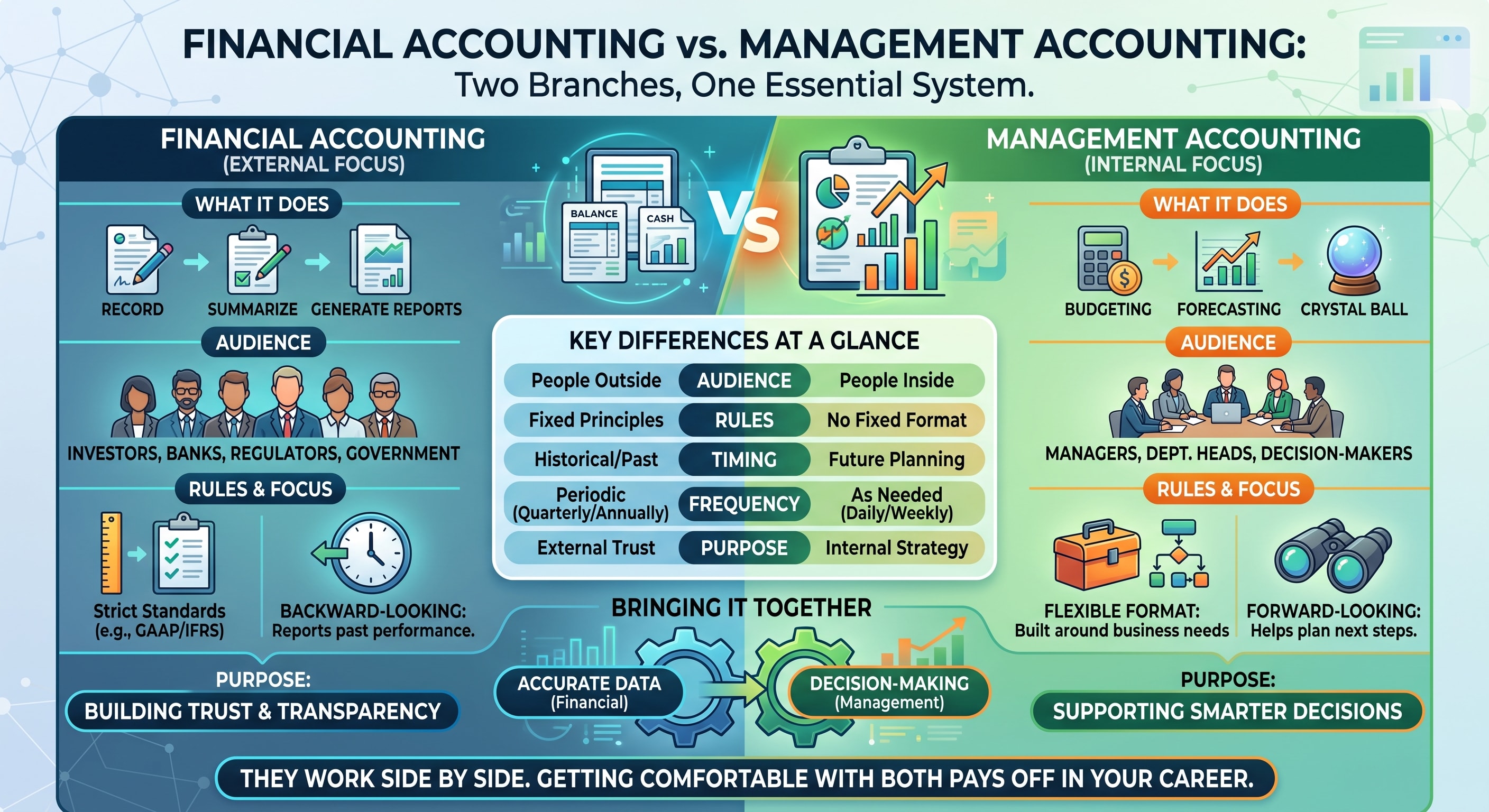
Financial accounting is about recording, summarizing, and reporting a company's financial activities in a standard format. The main output of financial accounting is a set of financial statements — like the income statement, balance sheet, and cash flow statement — that show how a business performed over a specific period.
The key thing about financial accounting is that it's meant for people outside the day-to-day operations of the business. This includes investors, banks, government bodies, and regulators. Because these outside parties need to trust the numbers, financial accounting follows strict, standardized rules. This is what makes financial reporting comparable across different companies and industries.
Financial accounting also looks backward. It reports on what already happened — last month, last quarter, last year. It answers the question: "How did we actually perform?"
What Management Accounting Does
Management accounting, on the other hand, is built for people inside the business — managers, department heads, and decision-makers. Its purpose isn't to satisfy outside parties, but to help the business make better decisions going forward.
This is where cost accounting, budgeting, forecasting, and performance analysis come in. A manager might use management accounting reports to decide whether to launch a new product, cut costs in a certain department, or adjust pricing. Unlike financial accounting, there's no fixed format here — reports are built around whatever information is most useful for the decision being made.
Management accounting also tends to look forward. Instead of just reporting what happened, it helps answer the question: "What should we do next?"
Key Differences at a Glance
- Audience: Financial accounting is for people outside the company. Management accounting is for people inside it.
- Rules: Financial accounting follows fixed accounting principles and standards. Management accounting has no fixed format — it's built around business needs.
- Timing: Financial accounting looks at the past. Management accounting focuses on future planning and decisions.
- Frequency: Financial statements are usually prepared periodically (quarterly, annually). Management accounting reports can be created as often as needed — even daily or weekly.
- Purpose: Financial accounting builds trust and transparency with outside parties. Management accounting supports internal decision-making.
Why This Difference Matters for Your Career
Understanding this distinction isn't just an exam topic — it shapes what kind of accounting work you might specialize in later. Some accountants focus almost entirely on financial reporting and audits, following strict accounting principles and preparing statements for external use. Others move into roles centered on budgeting, cost analysis, and internal strategy, where management accounting skills matter more.
Many accounting fundamentals courses teach both areas together because a solid grasp of financial accounting makes management accounting easier to understand, and vice versa. Numbers you learn to record accurately in financial accounting often become the raw material used in management accounting reports for decision-making.
Bringing It Together
Financial accounting and management accounting aren't competing systems — they work side by side. One builds trust with the outside world through accurate, standardized reporting. The other helps the people inside the business make smarter, faster decisions. Getting comfortable with both is one of the most useful accounting basics you can build early in your studies, and it pays off no matter which direction your accounting and finance career eventually takes.